We use cookies to enhance your browsing experience, serve personalised content, and analyse our traffic. By clicking "Accept All" you accept this and consent that we share this information with third parties and that your data may be processed in the USA. For more information, please read our .
You can adjust your preferences at any time. If you deny, we will use only the essential cookies and unfortunately, you will not receive any personalized content.

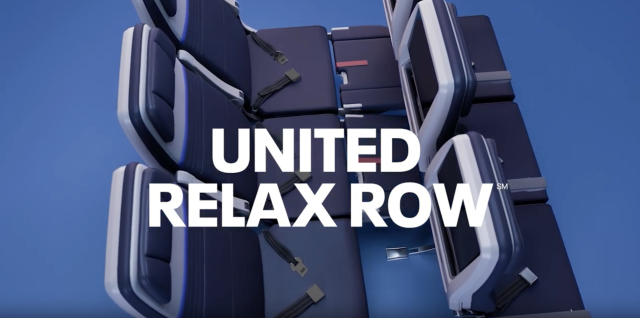
There is a very specific type of daydream that usually sets in around the six-hour mark of a long-haul flight. It involves a miraculously empty row, a mountain of airline blankets, and the wildly optimistic belief that you might actually manage a decent night's kip in Economy. United has now looked directly at that fantasy and decided to monetise it. Starting in 2027, the airline plans to introduce a new long-haul economy option called the Relax Row, a dedicated row of three seats that can be turned into a couch-like sleeping space.
United shared the news on X (formerly Twitter) yesterday, along with a short video showing how the Relax Row works in practice.
Source: Screenshot from United via X
The clip quickly made the rounds, and the reaction was overwhelmingly positive. Travelers immediately recognized what United was offering here: a version of that rare, lucky moment when you end up with an empty row and can actually stretch out.

You need to accept the cookies and privacy policy of this external service to view the content
For anyone who has spent a long-haul flight trying to sleep sitting upright, the appeal was pretty obvious. The idea that something like that could be available, and bookable, in economy is what got people’s attention.
United’s new Relax Row isn’t business class, nor is it premium economy. It’s a dedicated set of three seats in the regular economy cabin, designed to transform after takeoff into a more loungeable, sleepable surface. Each seat has an adjustable leg rest that folds up to create a flatter space across the row, and customers will also get a fitted mattress pad, extra pillows, a specially sized blanket, and, for families, a plush toy and kids’ travel kit.
Source: Screenshot from United via X
In practical terms, this is United’s attempt to create a middle-tier comfort option for people who don’t want to spend business-class money but also don’t want to spend eight or ten hours folded into the shape of a question mark. The airline says the product is especially aimed at families with small children, couples, and solo travelers who simply want more room. That feels about right. Anyone who’s ever silently celebrated an empty row on an overnight flight already understands the appeal.
United says it’ll begin rolling out Relax Row in 2027, with plans to add it to more than 200 Boeing 787 and 777 widebody aircraft by 2030. The rows will sit between standard economy and Premium Plus, and each aircraft could have as many as 12 Relax Row sections.
Source: Screenshot from United via X
There’s been a clear gap in airline seating for years, and this is a direct attempt to fill it.
There are plenty of travelers who’d happily pay more than a standard economy fare for extra comfort, but still can’t justify jumping all the way up to premium economy or business class. That group includes parents flying with young children, couples trying to survive a red-eye without arriving irritated at each other, and solo travelers who’d pay a few hundred extra dollars for the chance to lie down instead of pretending they can sleep upright.
Source: Screenshot from United via X
Airlines have gotten increasingly precise about segmenting cabins and pricing, and this fits neatly into that broader shift. It creates an option for people who want something better than economy, but still within reach.
It’s also not entirely new territory. Air New Zealand has offered its Skycouch product for years, and the fact that it’s still around suggests there’s consistent demand for this kind of in-between option. Airlines don’t keep products in rotation out of sentiment. If something stays, it’s because travelers are booking it.
So far, United hasn’t said what Relax Row will cost, and that’s the detail that’ll determine whether this becomes a hit or just a very polished press release.
If the pricing feels reasonable, this could be genuinely useful. A family of three on a long overnight flight might see obvious value in paying extra for a row that allows a child to stretch out and sleep. Couples may also be interested if the add-on costs less than buying two premium economy seats. Solo travelers are the trickier case, because the airline is effectively giving one person access to space that could otherwise hold three passengers. That usually gets expensive fast.
Air New Zealand’s pricing offers a useful reference point. Gary Leff at View from the Wing noted that Skycouch add-ons have ranged from several hundred dollars for couples to much higher for solo travelers. Two people sharing the space is probably the sweet spot. Three people can use it without displacing extra passengers, but the comfort level depends heavily on who those three people are. A family with a toddler is one thing. Three full-sized adults attempting to “relax” on a converted economy row is a very different visual.
Source: Screenshot from United via X
That’s also why the marketing language matters here. United is calling it a couch, which is directionally true, but travelers still need to keep their expectations tethered to physics. This is an economy row on a commercial airplane doing its absolute best.
Of all the groups United mentioned, families are probably the clearest fit.
Long-haul flying with small children is exhausting in a way that’s hard to explain to people who haven’t done it. Everything is harder. Sleep is harder. Meals are harder. Keeping a tired child comfortable in a confined space at 35,000 feet can feel like a social experiment designed by someone who has never actually traveled with a toddler. A row that can become a flatter, more contained place for a child to lie down could make a real difference, especially on overnight routes.
United is clearly leaning into that angle. The airline framed Relax Row as part of a broader family-travel strategy that already includes free family seating, children’s meals on some routes, family-friendly inflight entertainment, and a travel kit created with Sesame Street. That doesn’t mean every family will jump at this, especially once pricing is revealed, but it does suggest the airline sees this as more than a novelty. It’s an attempt to make long-haul economy feel a little more manageable for both parents and kids.
Source: Screenshot from United via X
Couples may be the other obvious audience, especially the ones who look at premium cabins and think, “That would be lovely, but absolutely not for that price.” Relax Row gives them another option. It’s not glamorous, but it might be practical, and practical comfort tends to sell surprisingly well.
Source: Screenshot from United via X
United’s Relax Row taps into something most travelers have quietly wanted for years. Yes, it’s essentially a branded version of the empty-row jackpot. Yes, it’s still economy, and no fitted mattress pad on earth can fully erase that fact. But it also speaks to a real gap in the market. There are many travelers who want more comfort, more space, and more sleep, but who aren’t willing or able to pay premium-cabin prices to get it.
If United prices this well, families and couples in particular may end up loving it. And if nothing else, it’s refreshing to see an airline acknowledge that what many economy passengers really want isn’t champagne or sliding doors. It’s just the chance to lie down like a human being for a few hours.
Source: Screenshot from United via X / Main Image Credit: Screenshot from United via X
United Relax Row is a new seating option in economy class that allows a row of three seats to convert into a flatter, couch-like space after takeoff. It’s designed to give passengers more room to stretch out, rest, or sleep on long-haul flights.
United says Relax Row is expected to launch in 2027, with a broader rollout across more than 200 long-haul aircraft by 2030.
The new seating will be installed on United’s Boeing 787 and Boeing 777 widebody aircraft, which are typically used for international long-haul routes.
Relax Row will sit between standard economy and Premium Plus, creating a middle option for travelers who want more space without upgrading to a premium cabin.
Each seat in the row has an adjustable leg rest that folds up to create a flatter surface across all three seats. United also provides a mattress pad, extra pillows, and a blanket to make the space more comfortable for resting or sleeping.
United says it’s ideal for families with small children, couples, and solo travelers who want more space. In practice, couples and families are likely the most natural fit, since they can share the row.
United has not announced pricing yet. Based on similar products from other airlines, it will likely cost more than standard economy but less than premium economy or business class.
No. Relax Row is still part of the economy cabin, but with added space and comfort. It does not include the full service or privacy of premium cabins.
Not entirely. Airlines like Air New Zealand have offered similar couch-style economy seating for years. United is the first North American airline to introduce this type of option.
In short, we don't know. BUT, if this idea catches on enough, we wouldn't be surprised to see other airlines following suit. Keep your eyes peeled for this one.