We use cookies to enhance your browsing experience, serve personalised content, and analyse our traffic. By clicking "Accept All" you accept this and consent that we share this information with third parties and that your data may be processed in the USA. For more information, please read our .
You can adjust your preferences at any time. If you deny, we will use only the essential cookies and unfortunately, you will not receive any personalized content.

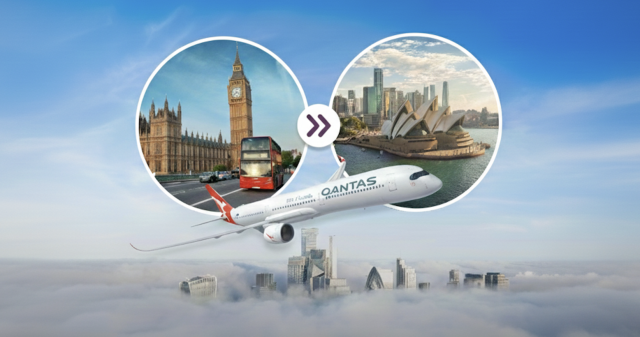
The world's longest flight is officially on the horizon. In 2027, Qantas plans to launch a nonstop commercial flight from London to Sydney, creating the longest passenger flight in the world at up to 22 hours in the air.
Known as Project Sunrise, the route will eliminate layovers, reducing the hours required for the current journey between the UK and Australia. Test flights are scheduled to begin in 2026, marking a significant step toward a future where travellers can fly non-stop from London to Sydney.
Flying from London to Sydney has long been one of the most demanding routes in commercial aviation. Even the fastest itineraries typically involve at least one stop and total travel times approaching 30 hours. Qantas’ nonstop London–Sydney service is designed to change that, offering a single continuous flight between the two cities.
Once launched, it will surpass Singapore Airlines’ New York–Singapore route to become the world’s longest nonstop passenger flight. The journey is so long that passengers will experience two sunrises during the flight, which inspired the name Project Sunrise.
The flight will be operated using a specially configured Airbus A350-1000 Ultra Long Range (ULR) aircraft. To cover the distance, the plane includes an additional fuel tank holding around 20,000 liters, allowing it to fly for up to 22 hours without refueling.
Qantas is also reducing passenger capacity to 238 seats, down from more than 300 on a typical long-haul aircraft. Fewer passengers mean less weight and more onboard space, both critical for a flight of this length.
Qantas has redesigned the onboard experience specifically for ultra-long-haul travel. Working with sleep and health specialists, the airline has adjusted lighting, meal timing, and inflight routines to help reduce fatigue and jet lag.
The aircraft will feature more space to move around, a dedicated wellness zone for stretching, and cabin environments designed to better align with natural circadian rhythms. The goal is not just to make the flight possible, but to make it manageable and comfortable for passengers spending nearly a full day in the air.
Qantas has confirmed that test flights will begin in 2026, with the first commercial nonstop London–Sydney flights expected to launch in early 2027. The airline is scheduled to receive the first of 12 new aircraft in late 2026.
Ticket prices are expected to be roughly 20 percent higher than current one-stop options, reflecting the convenience of flying point-to-point without layovers.
What is the world’s longest flight?
The world’s longest flight will be Qantas’ nonstop route from London to Sydney, lasting up to 22 hours.
When will the nonstop London–Sydney flight launch?
Commercial service is expected to begin in early 2027, with test flights starting in 2026.
Which airline is operating the world’s longest flight?
Qantas, Australia’s national airline, will operate the route as part of its Project Sunrise program.
What aircraft will be used for the flight?
A specially configured Airbus A350-1000 Ultra Long Range (ULR).
How long is the London to Sydney nonstop flight?
The flight will take up to 22 hours, depending on winds and routing.
Will this replace current flights with layovers?
No. One-stop routes will continue, but this offers a new nonstop option for travelers who value speed and convenience.
Why is it called Project Sunrise?
Passengers will see two sunrises during the flight due to the length of the journey and time zone changes.
Will the flight be more expensive?
Yes. Qantas has indicated fares may be around 20 percent higher than current one-stop flights.
Is this longer than the New York–Singapore flight?
Yes. It will surpass Singapore Airlines’ New York–Singapore route, currently the longest nonstop passenger flight.
Why does this flight matter?
It represents a major shift in long-haul travel, prioritizing nonstop convenience, reduced total travel time, and passenger wellbeing.